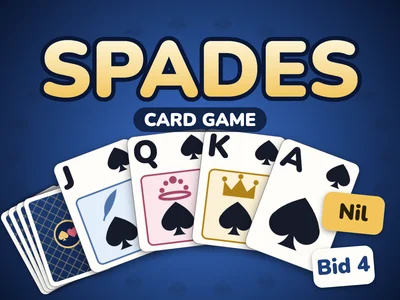
Spades: Free Online Card Game
Play Spades against the computer: you and a computer partner take on two computer opponents. Bid your tricks, try a nil, watch your bags and race to 500, or play the daily deal.
Quick facts
- Category
- 🎈 Casual
- Price
- Free, no download or sign-up
- Plays on
- Computer, phone and tablet
- Screen
- Portrait
- Provided by
- After School Play
- Added
About Spades: Card Game
Spades: Card Game is our own single-player take on the classic partnership trick-taking game. You sit at the bottom of the table, your computer partner Maya sits across from you, and two computer opponents sit at your sides. Spades are always trumps, and every deal is a small contest of judgment: say how many tricks you will take, then take exactly that many.
Each deal starts with the bid. Starting left of the dealer, every player bids once, from Nil to 13, and you and your partner's bids add up to your side's contract. The bid panel shows what everyone has bid so far and what your choice would mean for your side before you confirm it. Bid nil to promise you won't win a single trick: it is worth 100 points if you pull it off and costs 100 if you don't.
Then the cards are played. Follow suit if you can; if you can't, any card goes, and a spade beats everything else. No spade may be played on the first trick, and nobody may lead spades until one has been played on another suit. Cards you can't play are dimmed, every name plate shows tricks taken against tricks bid, and the toolbar keeps your side's running total in view. When every card you hold is sure to win, a button appears that takes all the remaining tricks at once.
Scoring is the standard game. Make your contract and score 10 points per trick bid, plus 1 for each extra trick; fall short and lose 10 per trick bid. Extra tricks are also bags, and every 10 bags cost 100 points, so a good side ducks the tricks it doesn't need. A nil bidder's tricks never help the partner's bid. The first side to 500 wins, and a side that falls to −200 loses. After every deal a summary card lists bids, tricks, contract points, nils, bags and penalties for both sides.
Choose Easy, Normal or Hard opponents. Easy players are relaxed and slip now and then; Normal players count tricks, chase sets, cover a partner's nil and try to break yours; Hard players deal out the unseen cards many times and play every option through to the end before they choose. Your partner always plays its best. You can also play to 300 instead of 500, switch the bag penalty off, or allow blind nil, a 200-point nil bid before you look at your cards when your side is 100 or more behind.
The daily deal gives everyone the same cards and the same computer players. Your score is your side's points on that one deal, out of a best possible 230 (a nil made plus a 13-trick bid made), and it goes on the leaderboard. Undo is free in normal games and switched off in the daily deal. The only paid item is a hint for 10 gems: during the bid it suggests a number and shows how it counted your tricks, and during play it marks the card the computer would choose from your seat. Hints never lower your score. Spades: Card Game is free to play in your browser with no download or sign-up, and its cards, sound effects and music are all made for the game.
Want more? Browse Casual games.
How to Play
- You sit at the bottom. Maya, across the table, is your partner; the players at your sides are your opponents.
- Each deal, bid how many tricks you will take, from Nil to 13. Your bid plus your partner's is your side's contract.
- Follow the suit that was led if you can. If you can't, play any card: spades are trumps and beat every other suit.
- No spades on the first trick, and spades can't be led until one has been played on another suit.
- Make your contract for 10 points per trick bid plus 1 per extra trick. Fall short and lose 10 per trick bid.
- Every 10 extra tricks (bags) cost 100 points. The first side to 500 wins.
Tips
- Count aces, kings with at least one card beside them, and spades: every spade past the fourth is usually a trick.
- Once your side has its tricks, play low cards and let the opponents win the rest, so the bags don't pile up.
- If your partner bid nil, win the tricks they might be forced to take, and play your high cards early.
- If an opponent bid nil, lead low cards and keep each trick cheap so they have to take one.
- Short in a suit? A spare spade can ruff it, so a void or singleton is worth counting in your bid.
FAQ
- Is Spades: Card Game free?
- Yes. It is free to play in any modern browser, with no download and no sign-up.
- What is a nil bid?
- Nil means you promise to win no tricks at all. You score 100 points if you manage it and lose 100 if you take even one trick. Your partner's tricks count only for their own bid, and a nil bidder's tricks never help the partner.
- What are bags?
- Every trick your side takes beyond its contract scores 1 point and adds a bag. Every 10 bags cost 100 points. You can switch the bag penalty off when you start a new game.
- How strong are the computer players?
- There are three levels. Easy players make the odd careless play, Normal players follow the rules a good club player uses, and Hard players deal out the unseen cards many times and play each option to the end before choosing. Your partner always plays at its best, and no computer player ever looks at your cards.
- How does the daily deal work?
- Everyone gets the same cards and the same computer players that day. You play one deal, and your score is your side's points on it, out of a best possible 230. A set or a broken nil scores zero on the board. There is no undo in the daily deal.
- What do gems buy?
- Only hints, at 10 gems each. A hint suggests a bid with its reasons, or shows the card the computer would play from your seat. You never need them, and they never lower your score.